01Background
The original motivation for this software was to simply edit and simulate logic circuits to help me develop a proprietary logic synthesis algorithm. I successfully developed the algorithm and then implemented it into the program. I then continued expanding and generalising the algorithm. In its current form, it can take any desired behaviour of a discrete system, and generate the most efficient combination of constituent subsystems. In other words, if you have some parts with defined behaviours, and you want to build a certain machine out of those parts, you can simply input the behaviour of the machine and it will tell you the most efficient way to arrange those parts, as long as your parts all have discrete states.
02Details
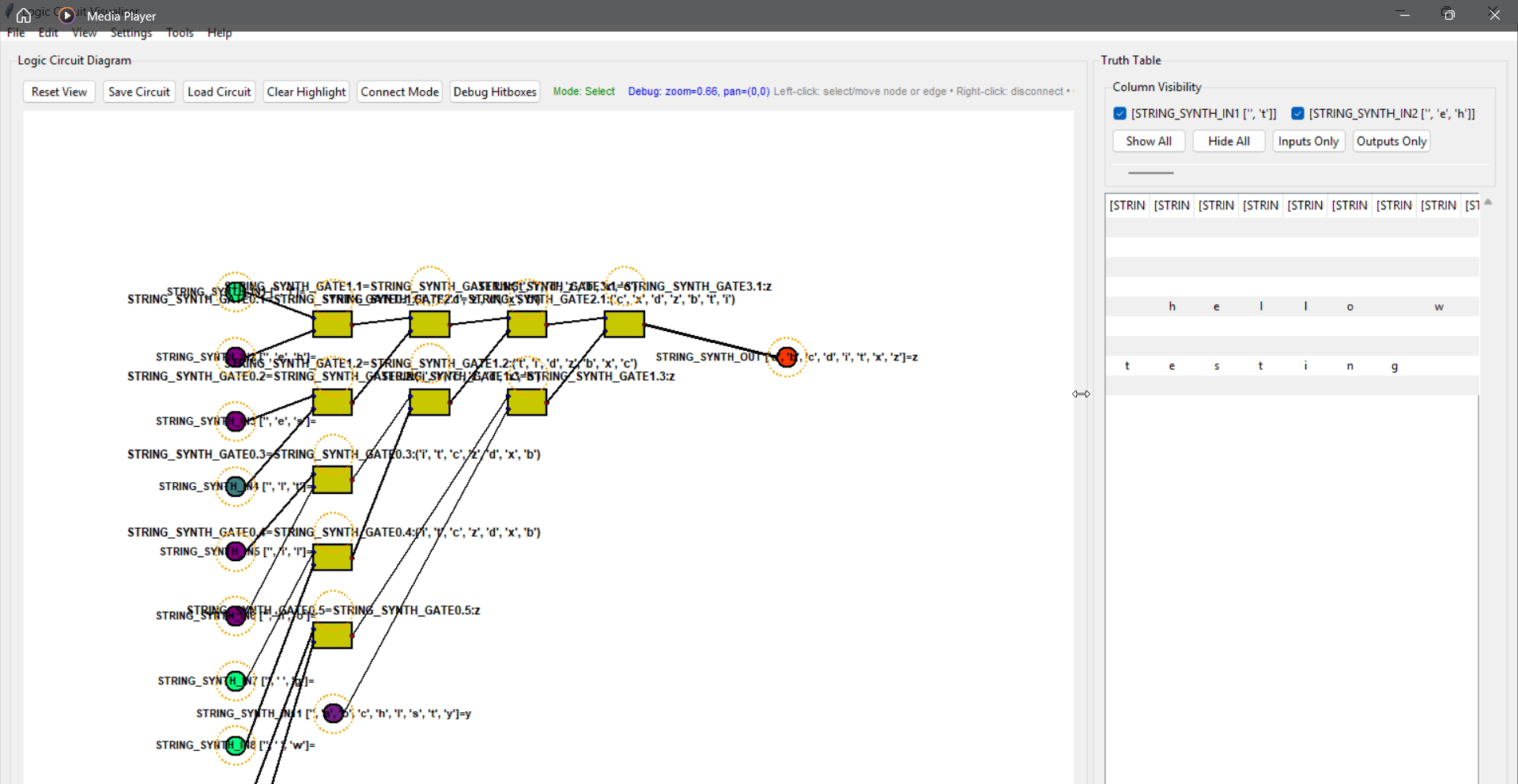
You can drag and drop logic gates into a diagram editor and wire them up. You can also create custom logic gates with custom truth tables. The output will be a big truth table for the behaviour of the whole circuit. The logic synthesis feature will allow you to edit the system behaviour (the big truth table) and then generate the simplest diagram of custom logic gates which achieves this behaviour. The key detail is that the truth tables don’t have to be in binary: you can input any string as a state. I defined the category of logic gates, with isomorphisms I call imvolutions. The circuit diagram then becomes the underlying graph of the category, where imvolutions are gates with one input and one output (the NOT gate is just an imvolution). Then, since these gates are custom and nonbinary, their truth tables become morphisms, and so the underlying graph is actually of a 2-category of the states given by the user, and the imvolutions are natural isomorphisms.
03Outcome
The software works beautifully and efficiently. I have yet to implement the request that certain morphisms (machine parts) be used in order to generate the behaviour, but this is a trivial task.
The program ma invent states that are more abstract combinations of other states, as intermediary to the output. These can be arbitrarily exchanged for additional dimensions in the domains of the morphisms. So can the number of generated gates in each layer of the diagram.