01Background
The module theme was urban play. We chose the assignment to develop a product that would support autistic social/sensory needs through exploration. We conducted user research by doing interviews, observations and workshops with potential users. We then used PCA and clustering methods to analyse the different interest groups and their needs. After feeding back out ideas through co-design sessions, we developed a puzzle game app which would make socialising more accessible by facilitating joint exploration. There would be a huge repository of puzzles with storylines that pertain to true information (history, geography, etc..) about the area.
02Details
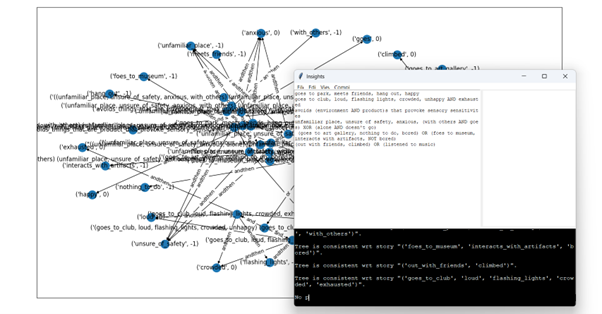
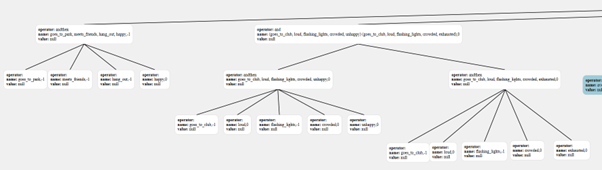
The game: The idea is that autistic people with different interests can enjoy exploring together as narratives that fit their interests are woven into puzzles that fit their aptitude in a complex and modular way, so that the experience doesn’t appear too formulaic. This allows us to generate narrative puzzles at scale, and engage the special interests of more users. I made a framework for representing the logical flow of a puzzle, so that puzzles with varying difficulty parameters could be generated separately from narratives. The crucial feasibility point for this app is that the puzzle can be generated separately from the narratives. The assignment: The project was split into research and R&D. Research was intended to develop a problem statement for a product that would achieve our goal, and R&D was intended to co-design and develop that product. In the solution, I built on my symbolic reasoning software to take all the stories from the interviewees and build a map of the different scenarios. Unlike in my Estimation of Needs using Survey Data, the stories were very heterogenous due to the nature of autism, and so we decided as a team to use a more discretionary approach. I was still able to use the data to search for logical contradictions in peoples’ responses, of which there were none (this is unfortunate as a contradiction could lead to insights).
03Outcome
The reasoning software was able to process the stories, although failed to collect characters from the story in all test cases. I never fixed this bug because the team priorities had moved on by this time.
The app demo worked for everything we wanted to demonstrate (the lobby, the buttons, the map, the game). All that was missing was a backend for user accounts and the game/story content. I will put up a video of the demo once I get the debug environment set up again.