01Background
The assignment was making airline seats more sustainable. I focussed on recycling of PU foam because there are many plastics like it which are theoretically recyclable yet not recycled. When looking at the seat from a systems perspective, I saw the underlying problem was not in the seat, but in the markets. My provocation is a way to leverage neural networks to coordinate information in recycling markets.
02Details
Process: The module was split into a research phase with a discovery report, and a solutions phase with a proposition. The discovery report was a group project, where we conducted a combination of desk research and primary research. We reverse-engineered and eco-audited an airline seat and spoke to industry. Our findings were that airlines had poor incentives and were slow to change. There was high embedded value in the scrap but only the aluminium was in some cases sold effectively. Weight was also the deciding factor of most design choices.
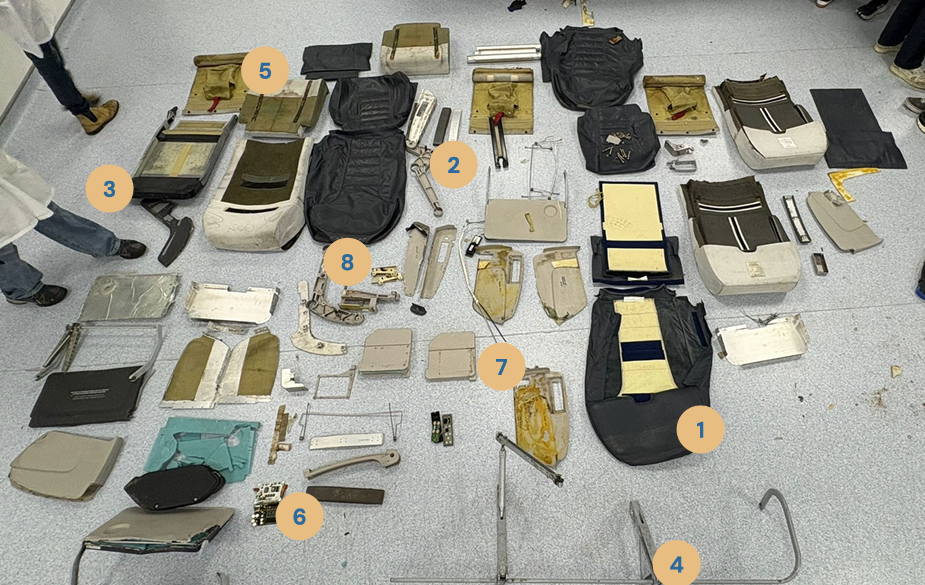
For the individual component, I focused on PU foam as only 1% of it is recycled yet it is well documented as recyclable material. I found that the reason it wasn’t recycled was due to high variance in scrap yield and capital-intensive recycling methods. Essentially, one expensive machine won’t be able to recycle much PU foam, so the trade isn’t worth it. The necessary information to know which machine parameters to use are scattered throughout the lifecycle of the material, but the incentives for sharing this information are not aligned. Arugument: I proposed that we use a CfD scheme similar to the renewable energy CfD scheme run by the British LCCC. The people are collectively affected by climate change and so the people must spend resources to stop it. Fuelled by government funding at the endpoint, algo traders using neural networks will be sufficiently incentivised to bet on the correct data to identify the correct recycling parameters for various sources of plastic scrap. Using vast pools of purchased data, their predictions make recycling viable and they receive a cut of the revenue set by the government’s strike price. It is not so easy to take data from other agents in the economy who would gain from keeping it private. Customers will prefer privacy and manufacturers will not risk revealing IP. This is the crux of the issue. I proposed processing the data in such a way that makes it unintelligible to anyone except the neural networks that are only able to use it for trading predictions. We do this by using the bottom half of the neural network as a hash function, or a neural mask. We distribute masks online and participants mask the data before transmitting it. Since neural networks are a black box, we cannot interpret the masked data, but the algo traders can input it into the top half of the neural network to complete the prediction. Everyone’s data is protected but the predictions, distributed across the economy, reach their destination at the recycling plants Why use a neural mask instead of just encrypting? Because when someone tells you the data is encrypted, you have no idea whether they are telling the truth or who holds the private keys. Furthermore, people are incentivised to decrypt the data. These are small issues but they matter when you are paranoid about sharing information. The best solution is to make the decryption task the same as the recycling allocation task. The data is processed over time into predictions. Public keys, agreements and communication protocols need to be established between parties who transfer encrypted data, creating an opportunity for inefficient selection of data sources. On the other hand, anyone can sell data to the algo traders if they think it correlates with the recycling outcome. If their data is unhelpful, then money dries up for them, regardless of who they are. Furthermore, the neural mask literally destroys the sensitive information you input and extracts only the variable features that influence the next layer. This makes it theoretically impossible to extract user data from the masked data. The only way to monetise the masked data is to process it and sell it to the algo trader, or copy the algo trader’s decisions. This would just make you another algo trader, contributing to the system and not undermining it.
03Outcome
The impact would be hard to quantify since this is a high-leverage solution, but in the report I mention how 1% of PU foam is recycled, and this figure could increase arbitrary, to the full market size of 77 million tonnes of CO2 saved from emission every year.