01Background
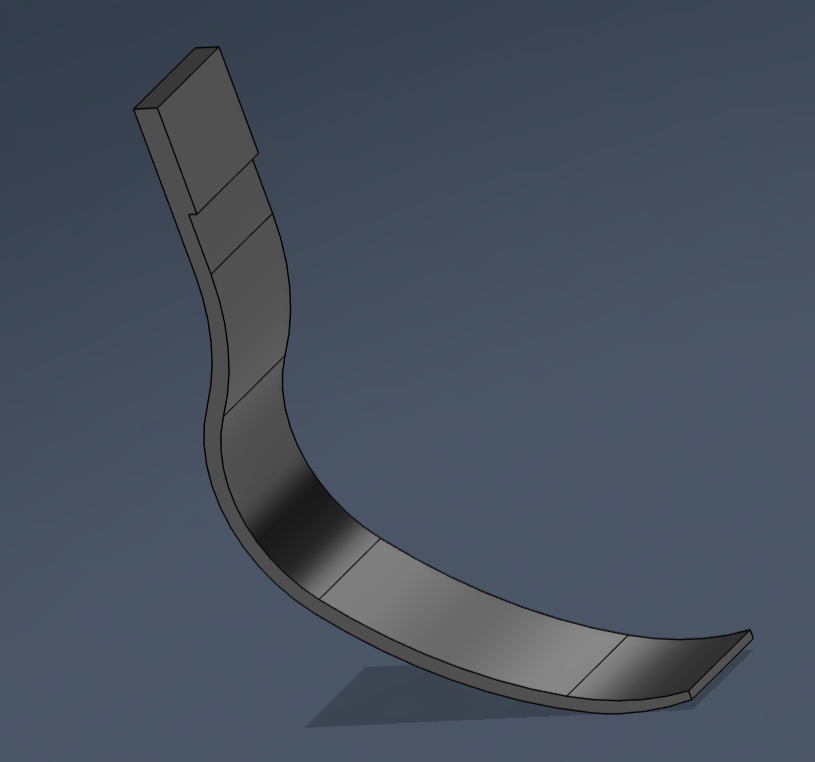
Running-specific prosthetic (RSP) blades take a shock from the ground with every stride. A blade that resonates with the running motion, or with the shock waves from each impact, passes that shock into the user's leg. A blade that fatigues quickly has to be replaced. But adding material to fix either problem makes the blade heavier and less athletic. For my Year 2 Finite Element Analysis module I took a published RSP design (Mitu, 2014), whose schematics are publicly available, and assessed its fatigue and vibration performance in two materials: Aluminium 2014 T4 and carbon-fibre reinforced polymer (CFRP). Earlier studies had analysed this design, but not its fatigue behaviour. I then proposed an improved design and tested it against three targets: a lowest resonant mode above 50 Hz, a fatigue life of at least 1,000,000 cycles, and a reasonable weight.
02Details
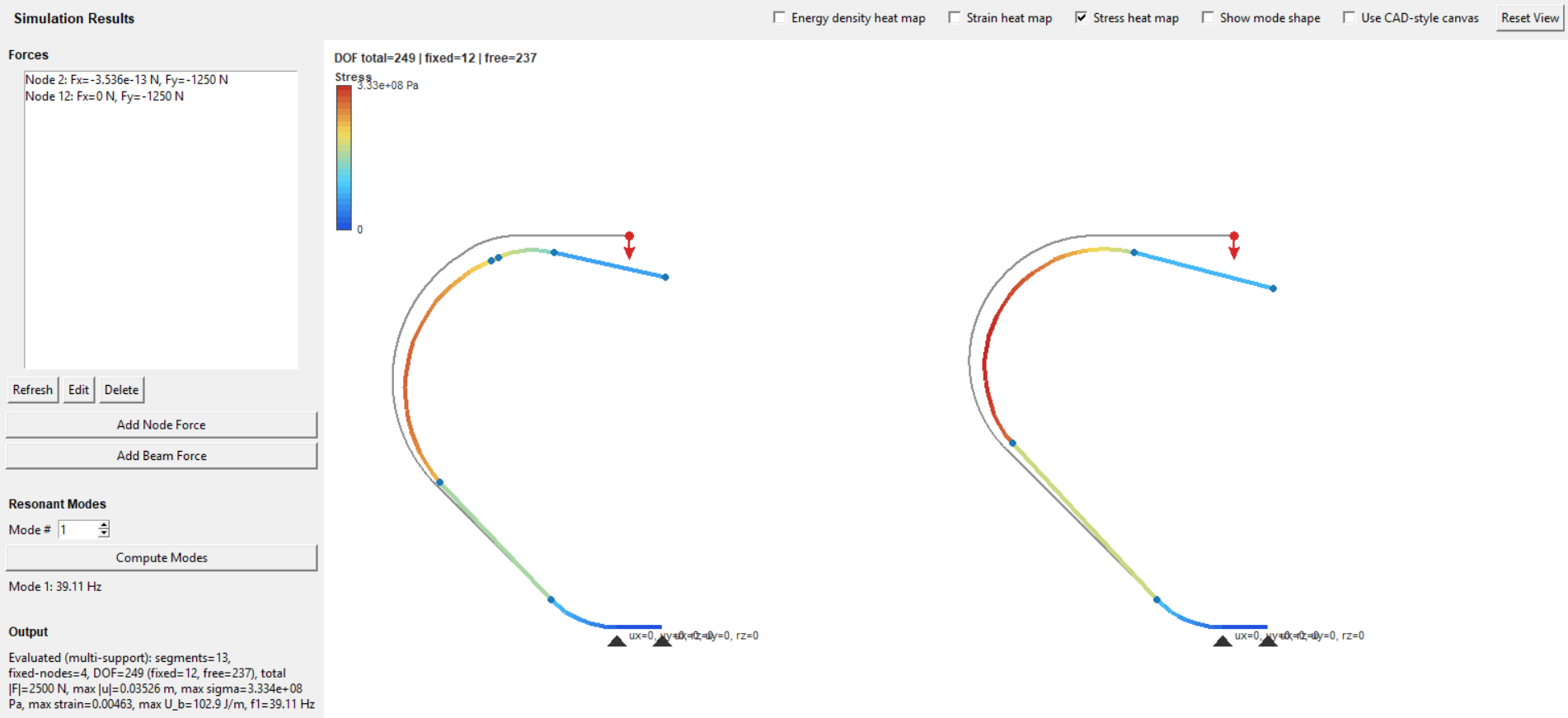
I took a two-layer approach: quick low-fidelity models to explore design ideas, then full 3D commercial FEA to assess the result. For the low-fidelity layer I wrote a standalone 2D FEA program in Python with SciPy. It has a beam editor and uses beam elements with C0 interpolation (GitHub Copilot helped with the tkinter interface). Alongside it, beam-theory simulations of a filleted right-angle bend showed that a wider fillet radius lowers peak stress and stiffens the bend, while changing the straight segments has the opposite effect. Comparing a cascade of arcs with a single fillet showed that lowering the average curvature reduces the maximum stress.
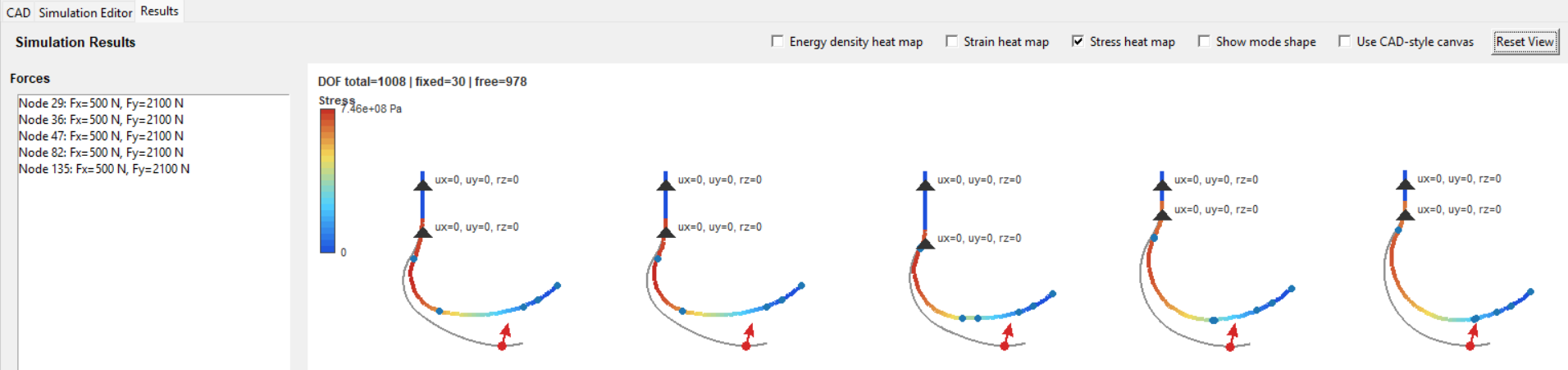
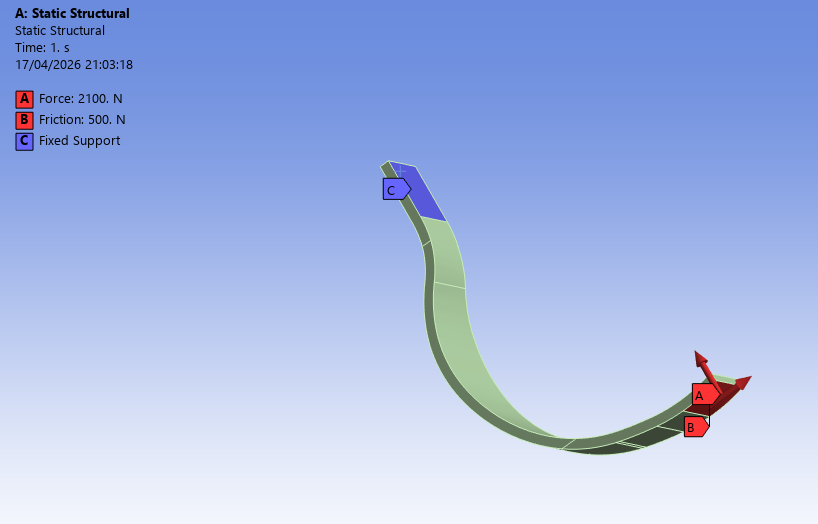
In Ansys Mechanical I modelled the blade as fixed where it bolts to the back of the leg, with a 2100 N vertical load (a 70 kg runner with a safety factor of 3) and 500 N of ground friction.
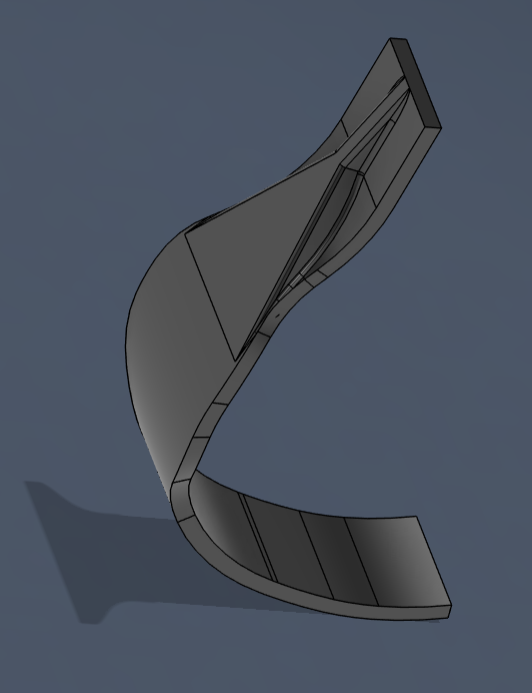
To choose the mesh size I used a golden section search on element size, stopping when results changed by about 1% or computing resources ran out, and checked aspect and Jacobian ratios. The final model used 322,308 quadratic tetrahedral elements. Each stride was modelled as a compression cycle with a stress ratio of zero. For ductile aluminium I used von Mises stress with the Gerber mean-stress correction and the S-N data built into Ansys. For brittle CFRP I used maximum principal stress with the Goodman correction and S-N data from published experiments. The modal analysis searched 0 to 500 Hz with the direct solver. Guided by the 2D results, the modified design adds an enlargement around the high-stress fillet, wider fillet radii and a chamfered support strut at the upper bend.
03Outcome
The modifications raised the fundamental frequency by 36% in aluminium (80.9 to 109.7 Hz) and 44% in CFRP (96.5 to 139.1 Hz), for about 100 g of extra mass, keeping the blade under 600 g. Peak stress fell from 0.47 to 0.35 GPa in aluminium and from 1.04 to 0.68 GPa in CFRP.
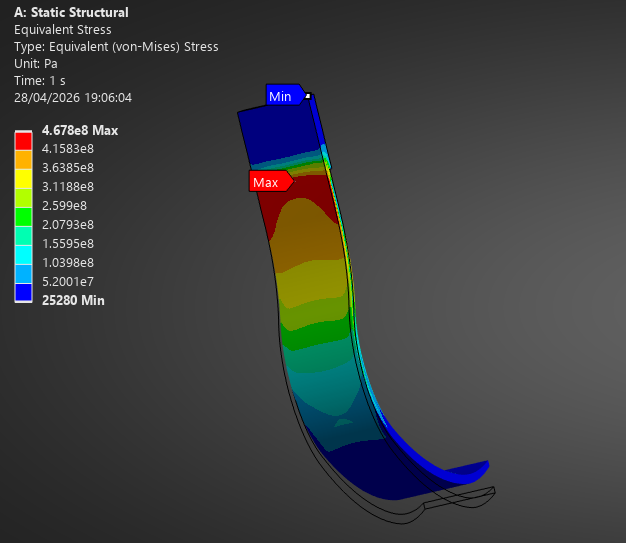
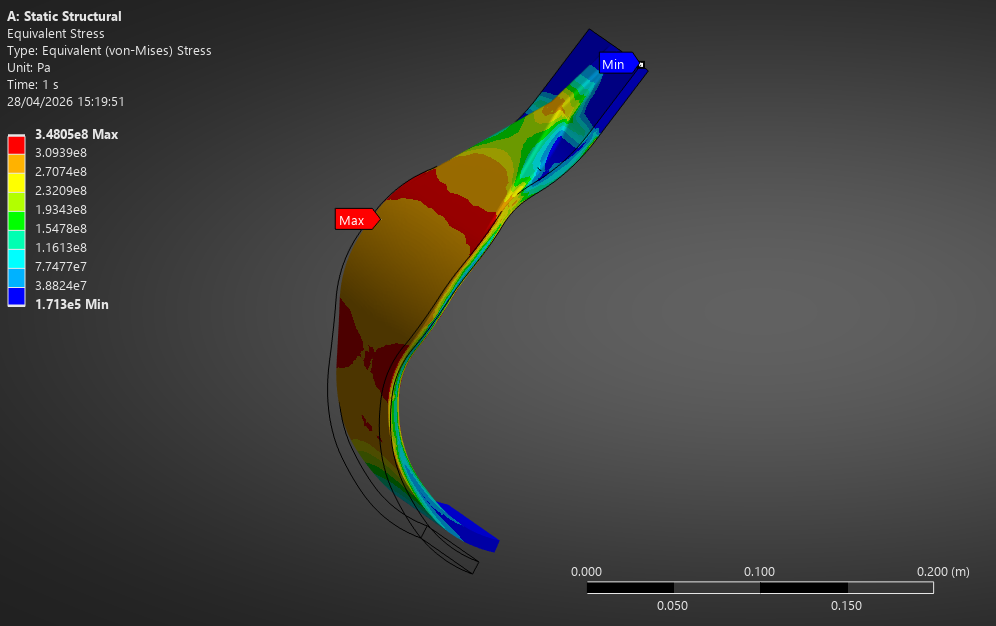
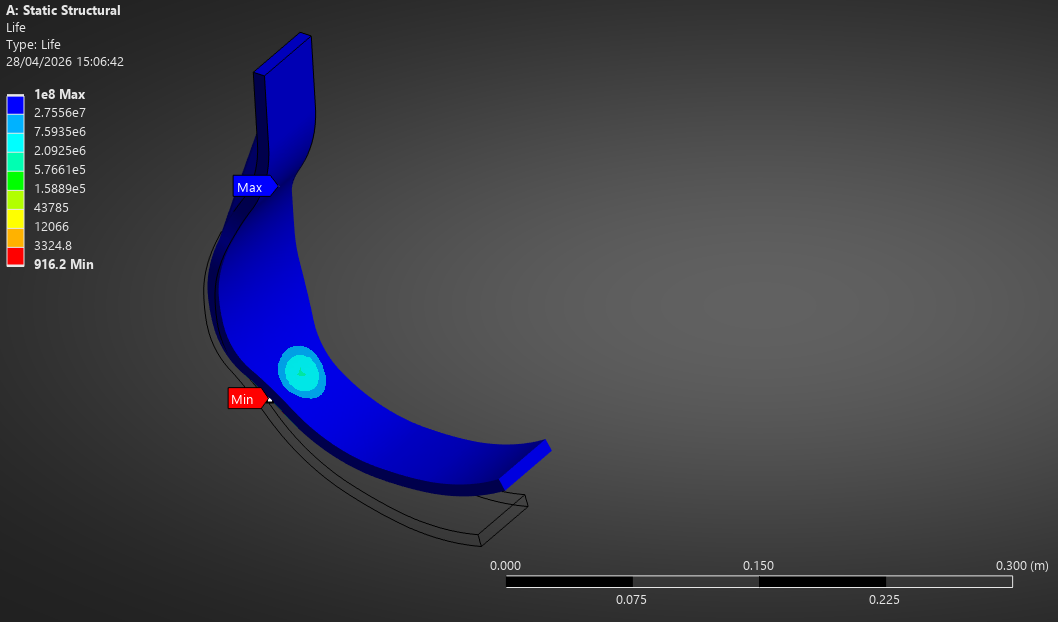
Fatigue life went from 0 cycles in both materials to about 18,000 cycles in aluminium and 900 in CFRP. That is a large improvement, but still well short of the 1,000,000-cycle target.
In the report I derived why the changes work. The relation between force and curvature in a curved beam shows that lower curvature reduces the normal pressure through a fillet, and the Rayleigh quotient shows that adding stiffness raises the resonant frequencies. The study was limited by computing resources, since peak stress hadn't fully converged, and the stiffer design may not return as much energy to spring the runner forward.