01Background
The original prompt for this software was to design materials by modelling the kinematics of bodies on a molecular-level. The stakeholder would be engineers and materials scientists developing new technologies. I knew that this software existed but I couldn’t get access to it, so I wanted to make it more accessible because I believe this is important for innovation. Realistically, I thought this would be an exciting project to diversify my skills away from programming.
02Details
The full report can be found here: Existing solutions use density functional theory (DFT) to approximate the Hamiltonian of a quantum system (such as a molecule) by ignoring nucleon-nucleon enthalpies and combining electron-electron enthalpy wavefunctions using the Hartree-Fock equation, essentially integrating the product of constituent wavefunctions to get probabilities. Implementing this method would have taken me beyond the 2-month deadline, so I changed my strategy. I modelled the molecular structures using simple VSEPR and doing tree-traversal to find isomers. The enthalpies of molecular bonds were modelled in polar coordinates using Coulomb’s law and accounting for electronegativity. I then used a bracketing method to find optimise spatial (angle) parameters for molecular enthalpy. Molecules were displayed in a 3D 1st person sandbox.
03Outcome
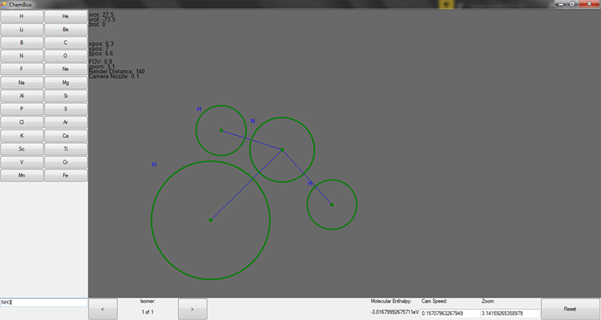
The user can click on one of a range of atoms to insert them into the environment, or alternatively write the chemical formula in the text input. The software will then generate a set of possible arrangements of those atoms. The software was broadly accurate within the limits of the chemistry laws themselves, save for stereoisomers (due to the tree-traversal algorithm) and certain molecules that were solutions to the three body problem.