01Background
I designed this computer architecture because I was frustrated with the idea of having to constantly read registers in loops in order to do event handling. Especially when it comes to checking for collisions between an object and every other object, which takes quadratic time. Instead, input comes from passive sensors and activates a node in the computer. Nodes will be connected to other nodes and fire given logic conditions. The signal will propagate through the computer according to rules written into the nodes by the commander. This means that the processor will be idle while there is no stimulus, only running the event handler loop as the sensor node is stimulated, saving compute time, and allowing simultaneous event handling as multiple stimuli will simply superpose.
02Details
Nodes:
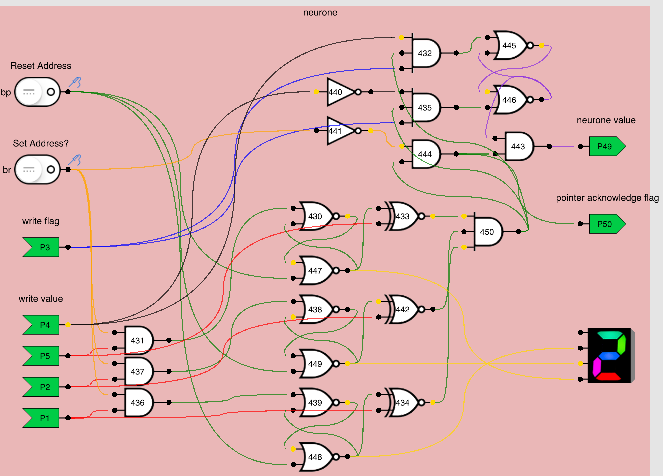
Each node has a memory cell for data, a memory cell for the output addresses and a selection of logic gates (AND/OR/NOT). When a data signal is sent from the commander, it passes through the selected logic gate and back to the commander with an output for each address. A sensor node may have a passive sensor instead of a logic gate and send output as and when the sensor is stimulated. Commander:
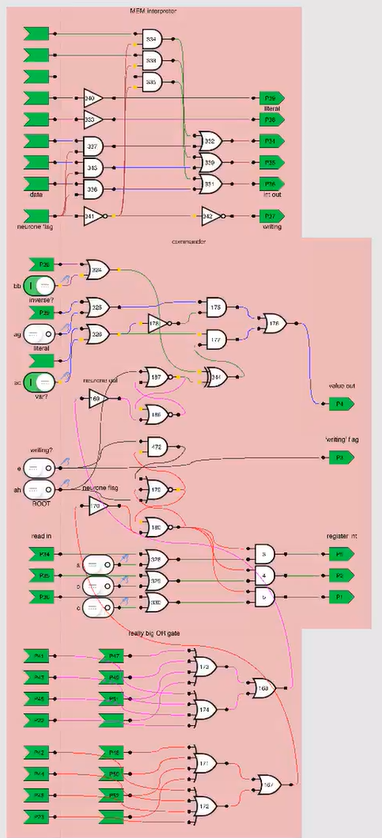
The commander is just a control panel for the user which would process machine code and write to the nodes. This is done via a bus which connects to all the nodes. There is a data bus, an output bus and a programming bus. Machine Code: The machine code is essentially a serialised tree/logic circuit, representing each node with the logic gate it should select. This could be a simple programmable logic controller or a full-fledged PC because it can read/write values, execute functions and interact with the environment at a scale that only depends on the number of nodes in the computer.
03Outcome
Successfully demonstrated a working PoC with basic arithmetic and logic operations. Proved feasibility of memory-integrated processing but identified scalability challenges.
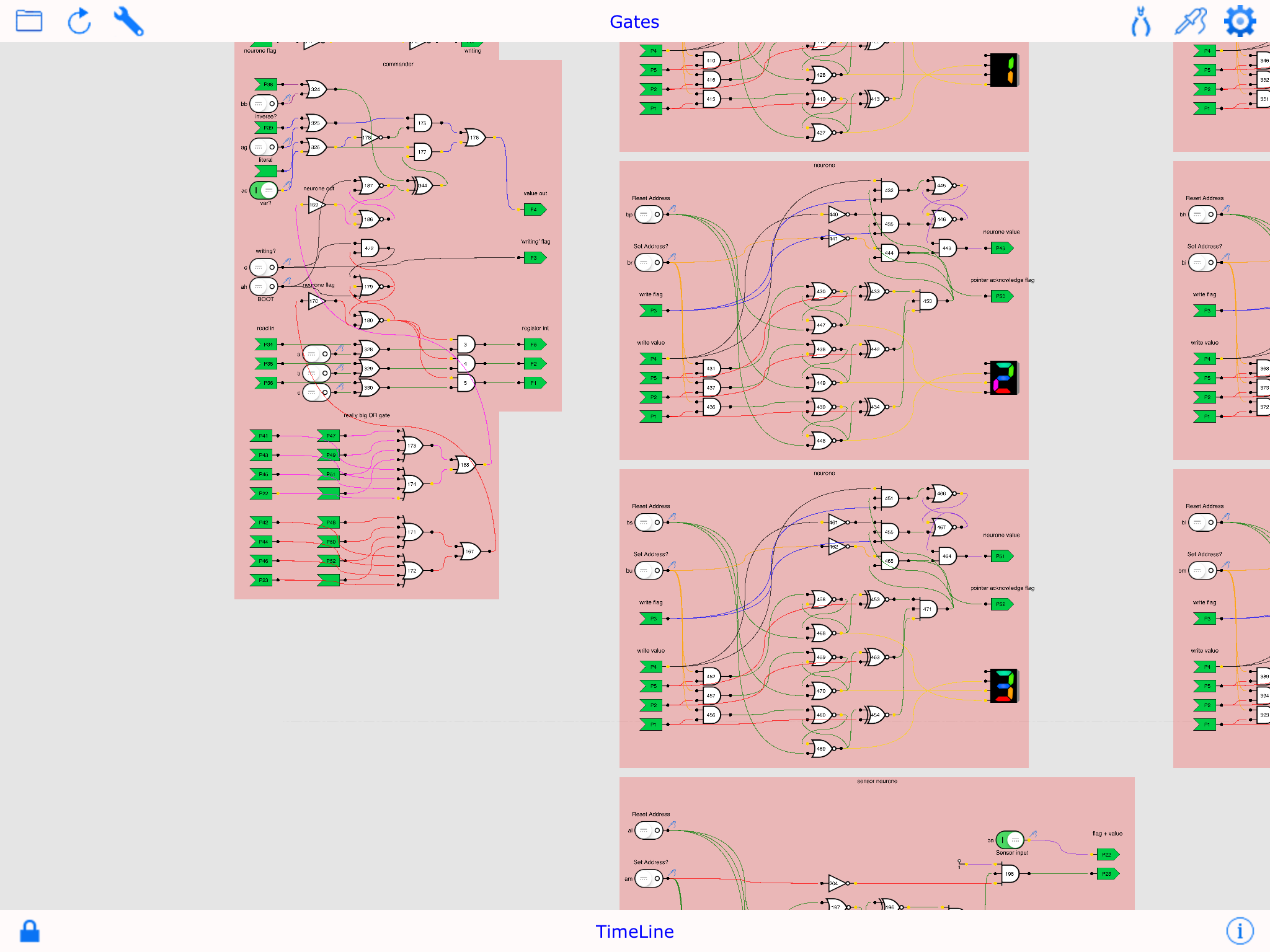
This demo shows the commander reading and writing to nodes which do small logic operations. To initialise, the addresses of the nodes need to be assigned for this simulator.